Ancient Fulani Elder Reveals a Forgotten Scalp Ritual That Helps Nigerian Women Grow Long, Thick, Healthy Hair — Without Expensive Products, Chemical Treatments or Salon Damage
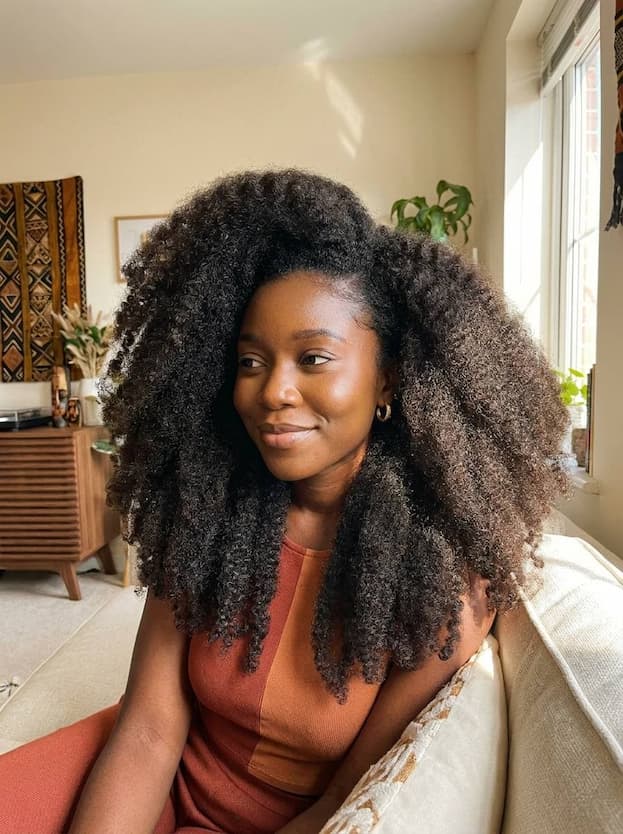
I want to ask you something personal.
And I need you to be honest with yourself when you answer.
When was the last time you looked at your hair — really looked at it — and felt proud?
Not the hair you show in photos with the right angle. Not the hair after you have spent three hours at the salon with someone else's hands in it. I mean your real hair. The hair on a Sunday morning before you do anything to it. The hair after a week of work and sweat and life. The hair that you see every day in the mirror when nobody else is watching.
When did you last look at that hair and smile?
"Why is it still this short? I have been trying for two years."
Maybe that is what goes through your mind. Or maybe it is something worse — maybe you have stopped measuring altogether because the disappointment of seeing the same number month after month has become too much to carry.
Maybe you have started timing how long you can go before the itch returns. Two days after washing. Sometimes one. You know the feeling — that low, insistent tingle at your scalp that starts quietly and builds until you cannot ignore it. Until you are scratching in a meeting. Scratching at a wedding. Scratching at the dinner table when you think no one can see your hand moving up to your head.
But they can see.
You know they can see.
And the dandruff. God, the dandruff.
White flakes on a dark blazer. White flakes on the back of a car seat. White flakes on the collar of a new dress that you bought specifically because you were trying to feel good about yourself for once.
You have stopped wearing black. Or if you do wear black, you brush your shoulders before you sit down anywhere — a quick, casual sweep of the hand that you have rehearsed so many times it is now completely automatic. You do it without thinking. You do it before church. Before meetings. Before family gatherings where everyone is already looking at you.
"Maybe it is the products. Let me try something else."
So you try something else. And something else after that. And something after that.
Your bathroom shelf has become a graveyard. Row after row of bottles and tubs and tubes that promised everything — growth, volume, moisture, shine, repair — and delivered nothing lasting. You spent real money on these things. You followed the instructions. You were patient. You gave each one time.
They failed you. Every single one.
The breakage never stopped. You know the specific sound of a comb moving through hair that is breaking — that soft, quiet snapping that you have learned to dread. Strands in the teeth of the comb. Strands on the pillow when you wake up. Strands in your hand when you run your fingers through. You stand over the bathroom sink and you watch them fall and you count them and you try not to count them at the same time.
Your hair grows — yes, it tries. But it breaks off at the same pace it grows. So you stay exactly in the same place. Same length. Same thinness. Same defeated feeling every wash day for the past two years.
People say things.
Not always with words. Sometimes it is just a look — that particular expression that crosses someone's face when they glance at your hair and quickly look away. Sometimes it is a well-meaning suggestion from a relative: "Have you tried the one with castor oil? My friend's daughter used it and her hair grew like this..." And you smile and nod and say you will try it, because it is easier than explaining that you have tried everything.
"Maybe this is just the way my hair is. Maybe some people's hair just doesn't grow."
I need you to hear me clearly right now.
Nothing is wrong with you.
Your hair knows how to grow. It was designed to grow. The problem is not your hair. The problem is not your genetics. The problem is not your effort.
The problem is that nobody has ever shown you where the real problem actually lives.
Until today.
Drop everything you are doing right now and read every single word I am about to share with you.
There is something our grandmothers knew about hair that the modern beauty industry has spent decades quietly burying.
Not because the old knowledge was wrong. Because it was free.
Before the shelves filled up with serums and the Instagram pages filled up with sponsored posts, African women — Fulani women especially — had hair that people still talk about today. Long. Thick. Deeply nourished from root to tip. Hair that grew without sulphate shampoos. Hair that stayed healthy without protein treatments. Hair that did not break at the ends and stay the same length for years on end.
Look at photographs of Fulani women from decades ago. Look at the hair in those photographs. Then look at your bathroom shelf and ask yourself honestly — with everything that shelf contains, are you closer to that hair or further from it?
Those women were not lucky. They were not genetically blessed beyond the rest of us. They had a system. A specific, deliberate, ancestral protocol passed quietly from mother to daughter, grandmother to granddaughter, through generations of women who understood something fundamental about hair that has since been forgotten.
They understood that hair does not come from the hair.
Hair comes from the scalp.
And the scalp must be healed before the hair can grow.
My name is Zainab.
The first thing you should know about me is that I am not a trichologist. I am not a hair coach, a certified natural hair specialist, or a beauty expert of any kind. I do not have a YouTube channel with tutorials or an Instagram page with a hundred thousand followers.
I am a Yoruba woman from Lagos who married into a Northern family, moved her life and her damaged, itching, flaking, breaking hair into a new city — and spent two years quietly suffering before one conversation with an elderly Fulani woman in Sokoto changed everything I thought I knew about why my hair refused to grow.
I am telling you this story because I know you are tired. Because I was tired too. And because what I found is too important to keep to myself.
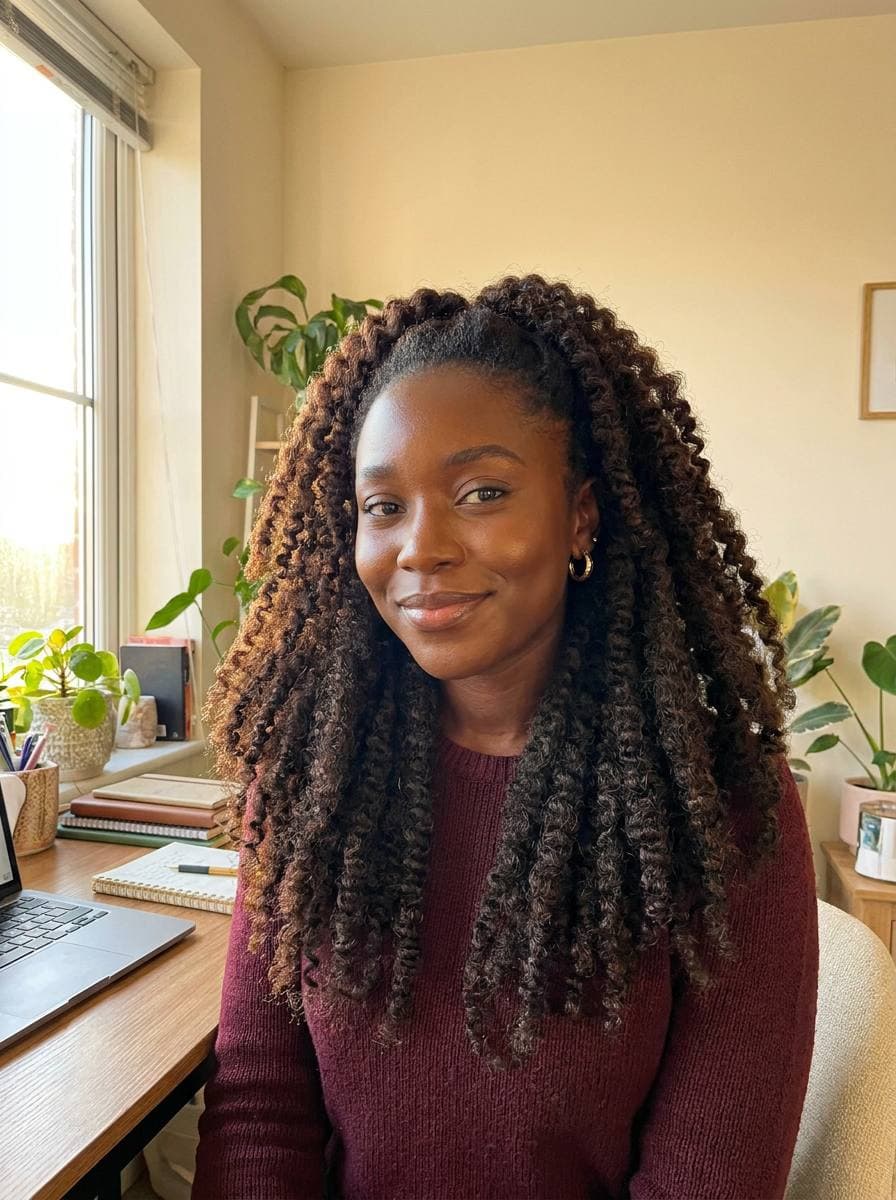
It started the year I got married.
I had always had full hair. Not perfect, but full. My mother used to call it my crown — thick enough that a single ponytail would fill her whole hand. I never appreciated it the way I should have.
Then I got married. We moved. Life changed completely. And slowly — so slowly I didn't notice at first — my hair began to change too.
The itch started first. A low-level, persistent tingle at my scalp that I kept scratching in the shower, thinking it would pass. It didn't pass. It deepened. By the fourth month in our new apartment in Lagos, I was waking up at 2am to scratch my scalp. By the sixth month I had tiny scabs from scratching too hard in my sleep.
Then the dandruff appeared. White flakes that showed up on my dark work blazer before I'd even left the house. I started keeping a lint roller on my desk. I started avoiding my favourite black dress. I started sitting with my back against walls so nobody could see my shoulders.
And then the breakage began. That was the worst part.
Every time I combed my hair, strands would come out in the teeth of the comb. Not a few strands — handfuls. I'd stand over the bathroom sink and watch them fall and try not to cry. My hair was visibly thinning at the front. I could see my scalp in places I had never been able to see it before.
"This is fine. This is normal. It will stop soon."
It did not stop.
My friend Amaka was the first person who said something directly. We were getting ready for an owambe one Saturday and she was helping me pin my gele. Her hands went still. Then she said, very gently — "Zainab, your hair... it has changed. Are you okay?"
I told her I was fine. I smiled. I changed the subject. But that night I cried in the bathroom for twenty minutes. Because she was right.
My aunt called me the following week. She said, "Zainab, stop letting them put chemicals on your hair. Go back to the old ways. Our mothers didn't have these problems."
I held onto that sentence for a long time. Our mothers didn't have these problems.
I tried everything.
I spent two months with medicated anti-dandruff shampoos — Head and Shoulders, Nizoral, Selsun Blue. They worked for exactly four to five days. Then the flakes came back, sometimes worse than before.
I tried tea tree oil treatments. Six weeks. The tingling felt like progress. It wasn't. My dandruff barely flinched and my hair kept breaking.
A colleague swore by biotin supplements. I bought a three-month supply. At the end of those three months I had gained less than half an inch. The money could have fed a family for a week.
I found a vendor on Instagram who sold a Fulani hair growth oil — thousands of followers, pictures of long hair in her highlights. I paid ₦12,000. The oil smelled beautiful. My hair remained exactly as it was. I left a comment asking if it was normal not to see results. She never replied.
I tried a scalp steaming treatment at an upmarket salon in Victoria Island. It cost me ₦18,500. My scalp felt amazing for three days. Then the itch returned.
Finally, I spent four months faithfully following a complete natural hair wash day routine from a popular YouTuber — pre-poo, shampoo, deep condition, LOC method, protective style. Every step. Every week. My hair was still the same length at the end of those four months.
"Maybe this is just the way my hair is. Maybe some people just don't grow hair."
That was my lowest point. That thought.
The trip to Sokoto happened three weeks after that thought.
My husband's family had a traditional gathering — an elderly great-uncle's 80th birthday. We drove up from Lagos, thirteen hours, arriving late and tired. I wore a headwrap the entire journey. My hair was at its worst that week.
On the second day, my husband's cousin Maryam found me in the kitchen and touched my arm. "Come. Nana Hauwa has been asking for you. She wants to meet the Lagos wife properly."
I followed Maryam to the far end of the compound where a large neem tree threw shade across a wide patch of bare ground. Nana Hauwa sat there in a wooden chair — 78 years old, small and perfectly straight-backed, dressed in deep indigo with her head wrapped in pale yellow. Her skin was dark and smooth the way of very old women who have spent no energy worrying about how they look. And her hair — the small amount visible at the edges of her wrap — was thick and white and unmistakably full.
We talked for a long time. She asked me about Lagos, about my work, about my husband as a boy. She was funny — drily, unexpectedly funny. And then, after perhaps thirty minutes, she looked at my hairline. Not quickly. Not casually. She looked at it with the slow, focused attention of someone reading something important.
Then she said something in Fulfulde. Maryam laughed softly before translating:
"She says your hair is hungry. Not for more products — hungry underneath, at the root. She says whoever is selling you things for your hair is growing rich while your hair grows thin."
I laughed too, surprised. Then I told Nana Hauwa — through Maryam — about everything I had tried. All of it. She listened to everything without interrupting. She did not look sympathetic. She looked entirely unsurprised.
When I finished, she was quiet for a long moment. She looked up at the neem tree above us. Then she spoke at length and Maryam translated carefully:
"You have been trying to grow a plant by polishing its leaves. You have been treating things that are already dead — because new healthy hair does not come from the hair that is already outside your head. It comes from underneath. From the scalp. And your scalp has been sick — blocked, inflamed, and starved of what it needs. Fulani women do not start with hair. We have never started with hair. We start with the scalp. The scalp is the soil. You cannot grow anything from sick soil no matter how much water you pour on the leaves. Fix the soil first. Everything else comes by itself."
— Nana Hauwa, 78, SokotoTranslated from Fulfulde by Maryam
The scalp is the soil.
Something shifted when Maryam said those words. Not dramatically. Quietly — like a door opening in a room I had been locked inside for two years. I had been treating my hair like a surface problem when it was a root problem. Of course nothing had worked. I had been fixing the wrong thing every single time.
For the next two hours, Nana Hauwa talked and Maryam translated and I typed into my phone with both hands. She described the scalp ritual her own grandmother had taught her as a young woman. Specific natural ingredients — applied in a specific order at a specific frequency. Not complicated. Not expensive. Available in any Northern Nigerian market or any African grocery in London, Houston, or Toronto.
At the very end, as we stood to leave, Nana Hauwa held my hand and said something brief. Maryam smiled and translated: "Stop spending money on your hair. Start spending time on your scalp. They are not the same thing. Your hair already knows how to grow. Stop fighting it. Start feeding it."
I started the protocol the night I arrived home.
Day one. Day two. Day three. Nothing dramatic. I kept going. On day four, I woke up and lay still for a moment before I moved. Something was different. My hands were not at my scalp. I had slept through the entire night without waking to scratch — for the first time in longer than I could clearly remember.
By the end of week one, the dandruff had visibly reduced. I wore a dark blazer to work on Friday and did not sweep my shoulders before I sat down in the morning meeting. I only noticed I had not done it when I was already seated.
Week three. A Tuesday morning. At my front hairline — in the exact place where my hairline had been retreating for two years — there were tiny new hairs. Baby hairs. Soft and short and unmistakably new.
I sat down on the edge of my bathtub. And I cried. Not from sadness — from the specific, overwhelming relief of someone who had quietly stopped believing something was possible and then been proven wrong.
Three months later, at an owambe, Amaka stopped mid-step when she saw me. She reached me and immediately put her hands on my head. She said, out loud, in the middle of the party: "ZAINAB. What did you DO? This hair is not the same hair."
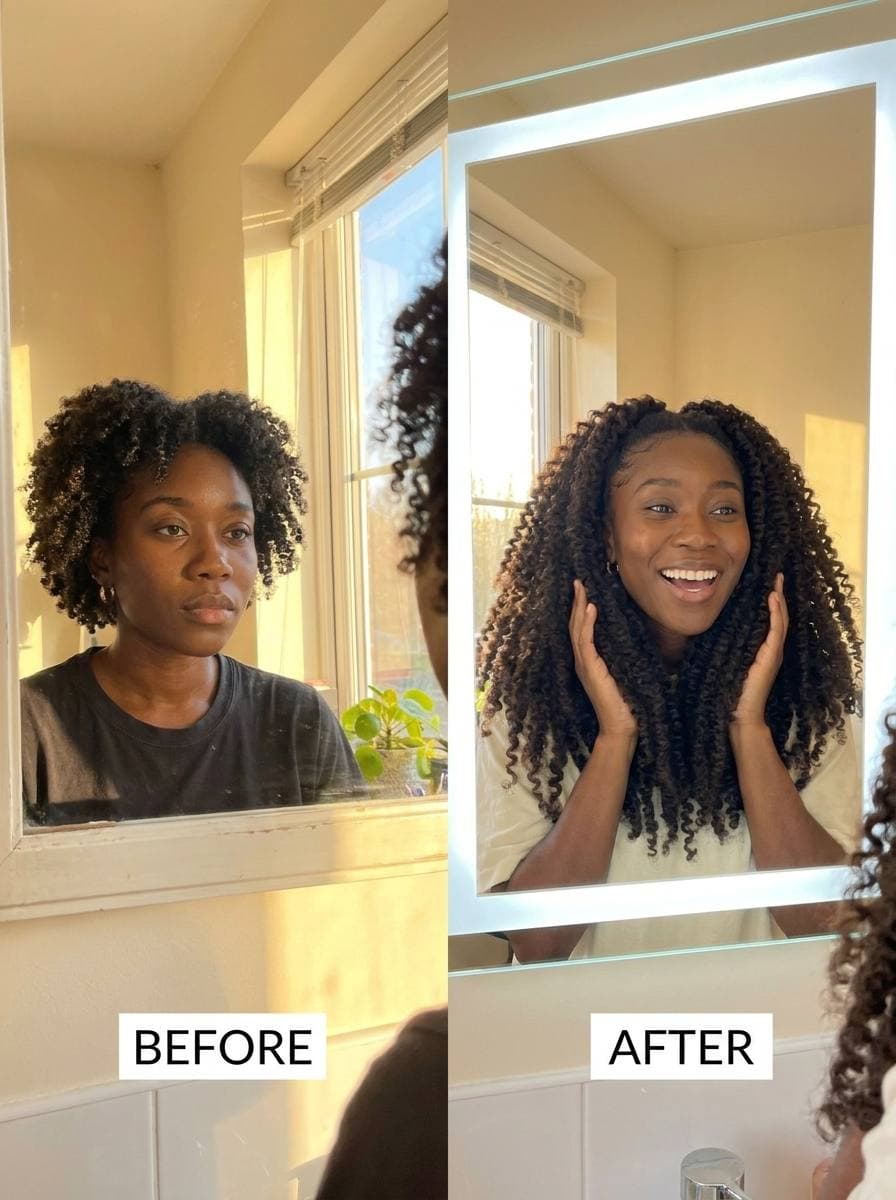
My hair had grown. Measurably, visibly grown — more in those three months than in the previous two years combined. The breakage had stopped. The dandruff was almost entirely gone.
Within six weeks of sharing with Amaka, she messaged me: "My edges are coming back. I am not joking with you."
That's when I knew I had to write this down properly. For every woman who has been where I was.
Zainab's hair journey — the transformation that started everything:
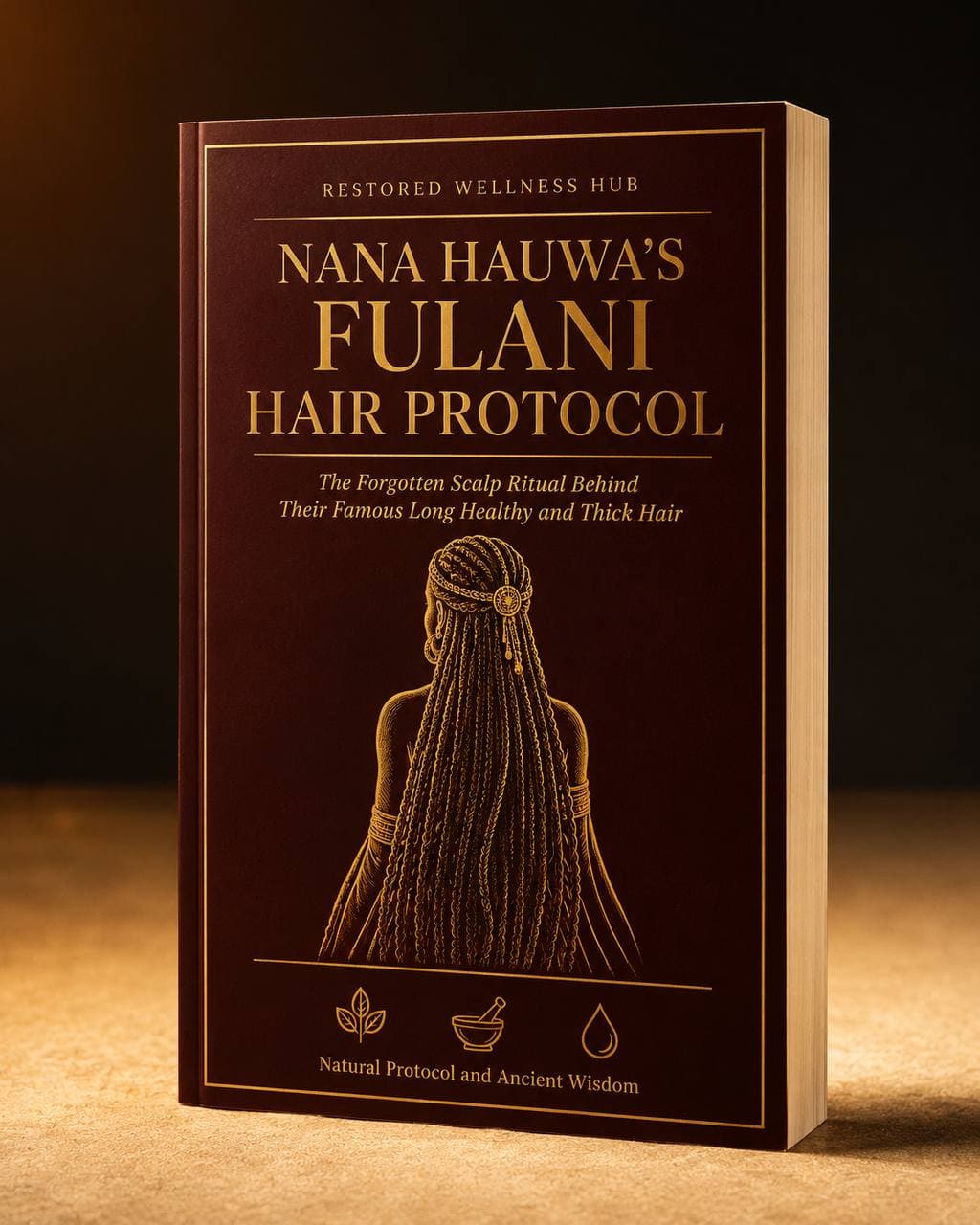
Nana Hauwa's Fulani Hair Protocol
The Forgotten Scalp Ritual Behind Their Famous Long, Healthy and Thick Hair —
Without Expensive Products, Chemical Treatments and Salon Damage
Inside This Guide, You'll Discover:
- The Scalp Root Cause Diagnostic — how to identify exactly which of the 4 root causes is behind your specific itch, dandruff, and breakage, so you stop treating symptoms and start treating the source. — Pg. 3
- The Overnight Nana Hauwa Scalp Detox — the exact two-ingredient preparation Fulani women apply the night before washing to dissolve buildup, calm inflammation, and reset the scalp environment. Your scalp will feel different from the very first morning wash. — Pg. 8
- The Fulani Follicle Activation Sequence — the precise order of natural ingredients used to reawaken dormant hair follicles and signal to your scalp that it is safe to grow again. This is the step that produces the baby hairs. — Pg. 14
- The Moisture Lock Method — how Fulani women seal moisture into the hair shaft to stop breakage permanently, using a specific oil application technique that most women do in completely the wrong order. — Pg. 19
- The Scalp Maintenance Ritual — the simple weekly and monthly care system that locks in all your results and keeps your scalp healthy for life. Three steps. Fifteen minutes. Done. — Pg. 24
- The Diaspora Adaptation Guide — for women in the UK, US, Canada, Ghana and Cameroon: how to adjust the protocol for hard water, cold dry climates, and different ingredient availability. — Pg. 29
- What to Absolutely Avoid — the 6 things most Nigerian women do regularly that are silently destroying their scalp health and preventing any growth protocol from working. — Pg. 32
And the best part? You don't need to visit an expensive salon, buy foreign products, or follow a complicated routine you'll abandon in two weeks. It's the same simple ancestral method that worked for me, for Amaka, and for over 200 women I have quietly shared it with since that trip to Sokoto.
Everything You've Already Tried Has Failed You. Here's Why.
Everything this protocol needs is available in your local market. Total cost of all ingredients? Less than ₦5,000.
Compare that to:
Medicated anti-dandruff shampoos: ₦4,000 – ₦8,000 (stop working in 4–5 days, flakes return worse)
Instagram "Fulani hair growth oils": ₦8,000 – ₦15,000 (vendor disappears the moment it doesn't work)
Salon scalp steaming treatments: ₦15,000 – ₦25,000 (feels good for 3 days, itch comes right back)
The REAL cost: your confidence, your wash days, your peace of mind
This protocol costs less than a single salon visit that won't even last the week.
Yet it has the power to give you back the hair you thought was gone for good.
Just So You Know... Putting This Guide Together Cost Me Over ₦120,000
- Professional writer to help document Nana Hauwa's protocol accurately — ₦35,000
- Two return trips to Sokoto to verify every detail with Nana Hauwa personally — ₦28,500
- Research and testing the protocol with 40 women before publishing — ₦22,000
- Professional design and layout of the guide — ₦18,000
- Website hosting, domain, and digital delivery platform — ₦16,500
I won't even charge you ₦60,000...
Not even ₦30,000...
Not even the fair price of
⚠️ This Discounted Price is ONLY For the First 30 Buyers — Act Now!
Secure payment via card, bank transfer, or USSD · Instant delivery to your email · Works on phone & computer
Real Conversations. Real Results.
Real messages from women on the protocol — swipe to read each story 👇
👆 Tap arrows or swipe to read each conversation
₦8,700 only · Instant access
More Women. More Results.
Testimonials shared directly with Zainab
My sister literally messaged me this morning to ask what I'm doing to my hair. She lives in Abuja, she saw me last month and now she's asking why my hair looks different. 5 weeks on the protocol. The breakage has reduced so much it's almost unbelievable. I used to cry every wash day. Now I look forward to it. Just buy it.
As a Hausa woman I was already familiar with some of these ingredients but had never used them this way. My dandruff is gone. Not reduced — GONE. I have been dealing with it for four years. Gone in three weeks. I have told every woman I know about this guide.
Honestly I bought it because of the price. At ₦8,700 I said even if it doesn't work I won't lose much. But it worked. It really worked. The overnight scalp treatment alone is worth ten times the price. My husband touched my hair last week and asked if I put something different in it. I just smiled. Ladies — this is the one.
🎁 WAIT — I Have FREE Gifts For You!
If you're among the first 30 buyers, you'll receive these powerful bonuses alongside your guide. TODAY ONLY.

The Fulani Hair Food Bible
Exactly what Fulani women eat that feeds their hair from the inside out — using everyday Nigerian foods already in your kitchen or local market. No supplements. No imported superfoods. Just the specific soups, seeds, oils, and drinks that nourish your scalp and accelerate the results of the protocol from inside. Valued at ₦5,000 — yours FREE.

The Fulani Scalp Oil Recipe Booklet
5 traditional Fulani hair oil blends you can make at home in 10 minutes using ingredients from any Nigerian market or African store. Each recipe targets a specific scalp concern — itch, dryness, growth, dandruff, and breakage. Valued at ₦4,000 — yours FREE.

💰 Let's Do The Maths
That is less than one box of medicated shampoo that will stop working in 5 days.
Less than a single salon visit that lasts 3 days.
₦8,700 only · Instant delivery · All bonuses included · First 30 buyers only
My 30-Day No-Questions-Asked Guarantee
You have tried things before that didn't work. You have every right to be cautious with your money.
Follow Nana Hauwa's Fulani Hair Protocol for 30 days. If your scalp has not calmed, your dandruff has not reduced, and you have not seen the beginning of real change in your hair — send me a message and I will refund every single kobo. No arguments. No long forms. No delay.
You risk nothing. The only thing you stand to lose is the itch, the flaking, and the years of being stuck at the same length.
Right now, you have two choices.
✅ Option 1 — Take Action Today
- Start the Overnight Scalp Detox tonight
- Feel the quiet where the itch used to be
- Watch the dandruff fade — for good
- See baby hairs appear at your hairline
- Grow past the lengths stuck for years
- Wear black without checking your shoulders
- Be the one people stop and ask: "What are you doing?"
❌ Option 2 — Close This Page
- Go back to the shelf of failed products
- Keep scratching in public
- Keep brushing your shoulders before sitting
- Measure your hair and see the same number
- Try another Instagram vendor
- Wonder later why you didn't just try this
⏰ Only 13 spots remain at ₦8,700. After that, price returns to ₦19,500.
₦8,700 only · Instant delivery
Questions People Ask Before Buying
Everything you need to know before you get started
₦8,700 · Instant delivery · First 30 buyers only
One last thing before you go...
I want to be honest with you about something.
I did not write this guide to get rich. If I wanted that, I would have priced it at ₦30,000 and kept it moving. I wrote it because I know exactly what it feels like to be the woman you are right now. The one who has tried everything. The one who has quietly, privately stopped hoping. The one who rehearses the shoulder-brush before sitting down and has told herself nobody notices — even though she knows they do.
I was that woman. For two years, I was her.
And Nana Hauwa gave me something that cost her absolutely nothing to give. Just knowledge. Just the truth her grandmother had handed to her, the same way her grandmother's grandmother had handed it down before that. She passed it to me under a neem tree in Sokoto like it was the most natural thing in the world. No drama. No price tag. Just: here is what you need to know. Now go and fix your soil.
I want to do the same for you.
You deserve to have hair that makes you smile when you look in the mirror on a Sunday morning with nothing in it. Not because it is perfect — but because it is yours, and it is healthy, and it is finally, visibly, undeniably growing. You deserve to run your fingers through it and feel thickness where there used to be thinness. You deserve to sit down at a dinner table, at a wedding, at a work meeting — in a black dress if you want — and not think about your hair once.
That is what this guide is for. That is the only reason I wrote it.
I am rooting for your scalp. I am rooting for your hair. And most of all, I am rooting for that specific moment — maybe day four, maybe week three — when you wake up and something is quietly, finally, different. When your hand is not at your scalp before you even open your eyes. When you stand at the bathroom mirror and lean in close and see something small and soft and new at your hairline.
That moment is waiting for you. It is already there — your hair just needs the soil to be ready for it.
With love,
Zainab ✦
P.S. If you're still on this page, something in you already knows what you need to do. You've read Tolu's story. Adaeze's black dress moment. Rukayat's mum calling from Lagos on a video chat and stopping mid-sentence. You've read what Nana Hauwa said under that neem tree. The only thing standing between you and a scalp that actually heals is the decision you make in the next few seconds. Every day you wait is another day of the itch. Another day of flakes. Another day your hair stays stuck at the same length.
P.P.S. The ₦8,700 price is only for the first 30 buyers. After that, the price goes back to ₦19,500. I set this limit because every woman who purchases gets my personal support if she has questions along the way — and I can only properly support a limited number of women at once. Once those 30 spots are gone, this price goes with them. I cannot hold it for anyone.
P.P.P.S. Over 200 women have quietly used this protocol since that trip to Sokoto. Some of them are in Lagos. Some are in London and Houston and Accra. Some had 4C natural hair. Some had relaxed hair. Some had been stuck at the same length for three years. Some had dandruff so bad they had stopped wearing certain colours entirely. What they all had in common was a scalp that needed healing — and hair that was waiting for someone to fix the soil. Yours is waiting too.
₦8,700 one-time · Instant delivery
Questions? Email: hello@restoredwellnesshub.com
Results may vary. This is a digital product delivered via email immediately after payment.